Robot dogs for inspection: where rovers stopUnitree A2 Pro quadruped robot with payloads configured by DroneBase
Tunnels, plants and confined spaces: the A2 Pro is an industrial quadruped platform that climbs steps, stairs, gratings and rubble, carries up to 25 kg of sensors while walking and stays operational for hours. DroneBase integrates it with the payload your application needs — thermal, gas and dust, fire detection, SLAM mapping, robotic arms — or develops a bespoke one.
Manufacturer data measured under laboratory conditions. Real-world performance varies with configuration, payload, terrain and operating conditions.
The problem is not seeing. It is getting there.
Tunnels, ducts, cavities, substations, tanks, silos, service tunnels, post-event areas. These are environments where data is needed — temperature, gas, geometry, structural integrity — but where the way of collecting it is the real bottleneck.
The operator goes in with a work permit, PPE, a rescue team and long lead times. The wheeled or tracked rover stops at the first step, the first threshold, the first pile of debris. The drone, with no GPS and tight spaces, works poorly and only for a few minutes.
A quadruped robot solves the missing part: it carries the sensor right into the environment, walking on surfaces a wheeled or tracked vehicle generally cannot handle, and stays there for hours.
Inspection with an operator
A confined space requires a work permit, preliminary atmosphere testing, PPE, external monitoring and a rescue team. The cost is not the survey itself: it is the organisation that makes it possible and the residual risk that remains with the company regardless.
Wheeled or tracked rovers
Excellent on regular flooring. But a step, a threshold, an industrial staircase, a grating, a pile of rubble or a gutter cuts the mission short. The limit is not the sensor on board: it is the mobility of the vehicle carrying it.
Drones in enclosed environments
In tunnels and confined volumes there is no GPS and no room to manoeuvre, flight time is measured in tens of minutes and the airflow stirs up dust. It remains the right tool for large volumes and heights, not for long routes a few metres above the ground.
A level of agility a wheeled vehicle cannot replicate
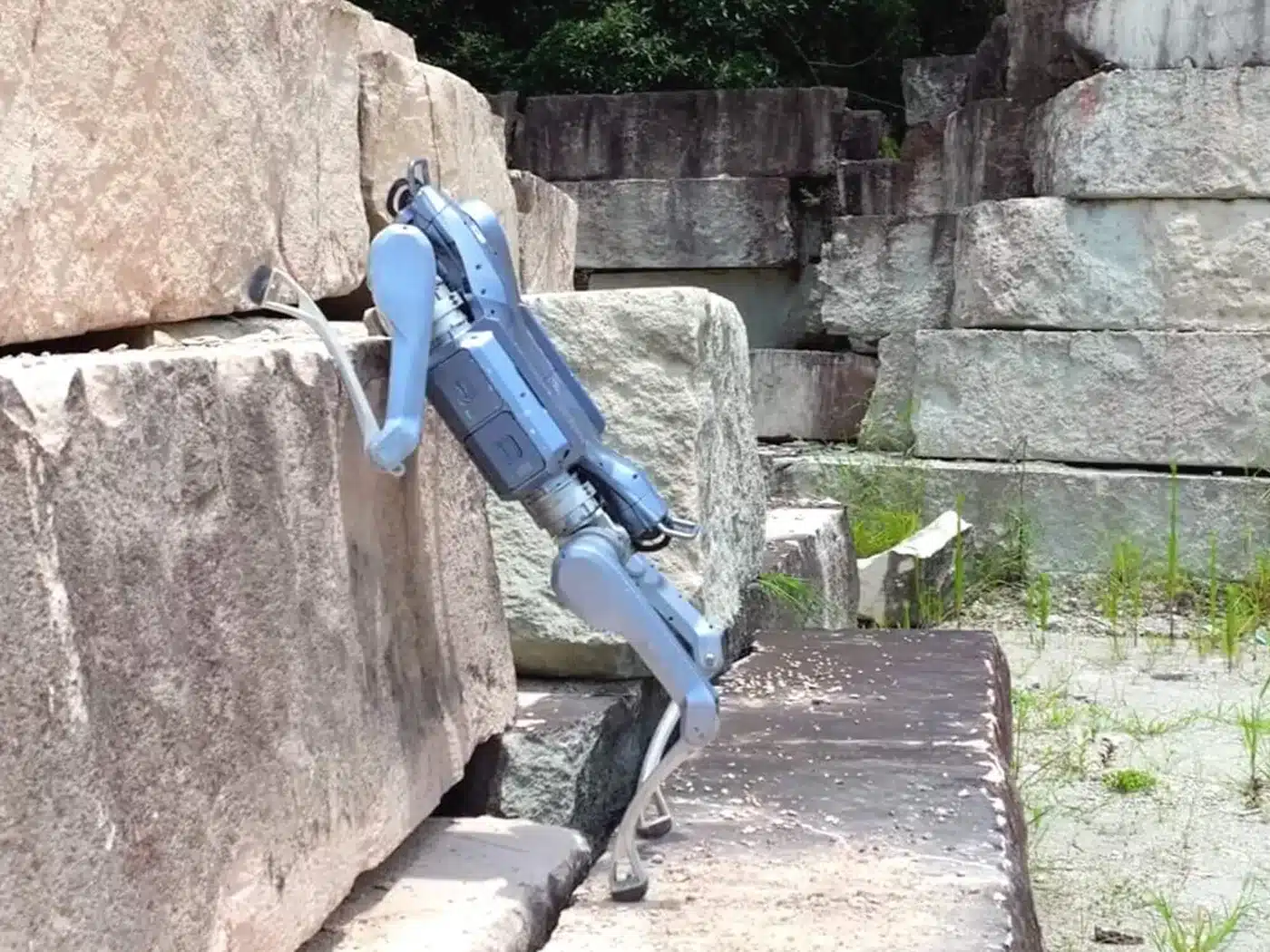
The difference is not incremental. A rover crosses a surface: it needs a continuous, sufficiently regular path. A quadruped chooses where to place every single foot, and this radically changes the range of environments it can reach.
Twelve joint actuators with a peak torque of around 180 N·m, dual industrial LiDAR front and rear, HD camera and front headlight: the A2 Pro builds its own map of the environment and adapts its gait to the terrain while keeping the load stable.
It climbs stairs and steps up to 30 cm, tackles slopes up to 45°, overcomes obstacles and rough terrain, moves at up to around 5 m/s in open spaces and slows to a walking pace where precision is needed.
Where the mission really changes
Qualitative comparison between a wheeled or tracked mobile platform and the A2 Pro quadruped platform under typical industrial and infrastructure inspection conditions.
| Condition | Wheeled / tracked rover | Unitree A2 Pro |
|---|---|---|
| Steps and industrial stairs | Blocking obstacle in most cases | Steps up to 30 cm, stairs negotiable |
| Slopes | Limited by grip and tipping risk | Up to 45° declared |
| Rough terrain, rubble, gratings | Requires a continuous, regular path | Selective foot placement, point by point |
| Footprint in tight spaces | Turning radius and width are limiting | Turns on the spot, adaptive gait |
| Sensor load carried | Varies with vehicle class | 25 kg while walking, 100 kg static |
| Operational continuity | Downtime for recharging | Dual hot-swap battery, change without powering down |
| Integrated perception | Depends on the fit-out | Dual industrial LiDAR + HD camera + headlight |
One platform. The payload defines the mission.
The A2 Pro is an open mobile base: 25 kg of payload while walking, on-board power and standard interfaces (Ethernet, USB, CAN/RS485, Wi-Fi 6) for integrating sensors and actuators. DroneBase takes care of mounting, power, communication and data-management software.
Dual-sensor gimbal: thermal + visible
Stabilised head with a radiometric thermal sensor and a visible sensor on the same axis: electrical and mechanical inspection, hot-spot detection, leaks, heat loss and night-time checks, with an aligned visible image for reporting.
- Applications: switchboards, motors, bearings, insulation
- Output: radiometric images, video, temperature readings
- Model and resolution: defined during configuration
- In the shop: Thermal + daylight gimbal camera kit for Unitree A2 →
Gas and fine-dust sensors
Multi-gas detection and particulate measurement directly on board the robot: sampling takes place inside the environment, before anyone enters it. Readings are transmitted in real time to the remote station and tied to the position along the route.
- Applications: confined spaces, tanks, tunnels, storage areas, post-event areas
- Output: georeferenced concentrations, alarm thresholds, mission logs
- Monitored gases and cells: defined on the basis of the site risk
Fire detection and thermal surveillance
Scheduled patrols on recurring routes with thermal analysis of critical points: storage areas, storage plants, production lines, areas at risk of self-ignition. The anomaly is detected at an early stage, when intervention is still straightforward.
- Applications: industrial plants, waste & recycling, warehouses
- Modes: scheduled patrol, alarm verification, night-time watch
- Integration with control room/BMS: assessed case by case
3D SLAM mapping of tunnels and confined spaces
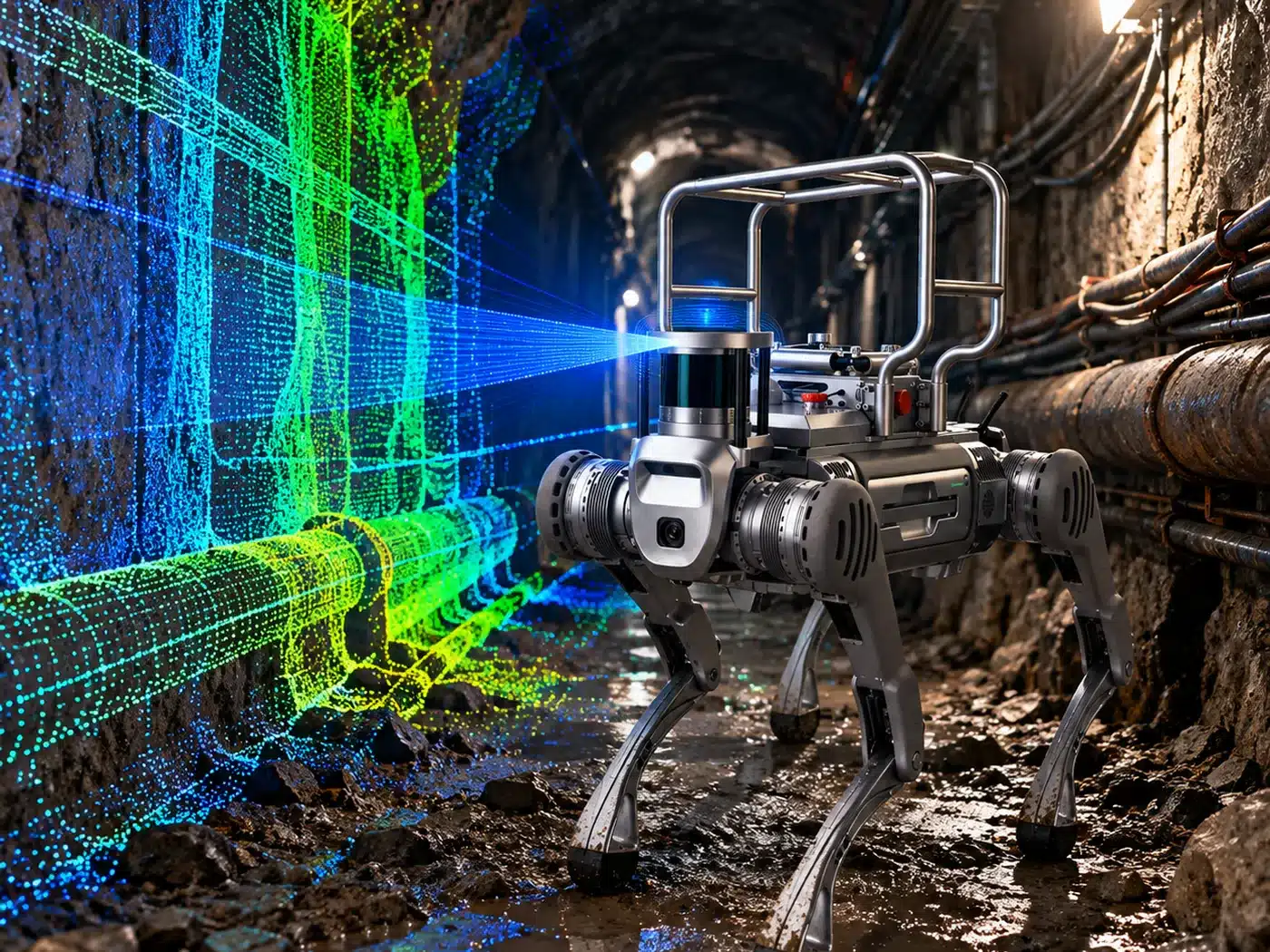
Scanning of the environment while walking, with no GPS: the robot builds the map as it advances and returns a navigable point cloud of tunnels, ducts, cavities and industrial volumes that are hard to survey with static instruments.
- Applications: tunnels, service tunnels, underpasses, quarries, plant rooms
- Output: point cloud, cross-sections, 3D model, comparison between surveys over time
- Accuracy: depends on the chosen sensor, defined per configuration
Robotic arm with VR control and depth camera
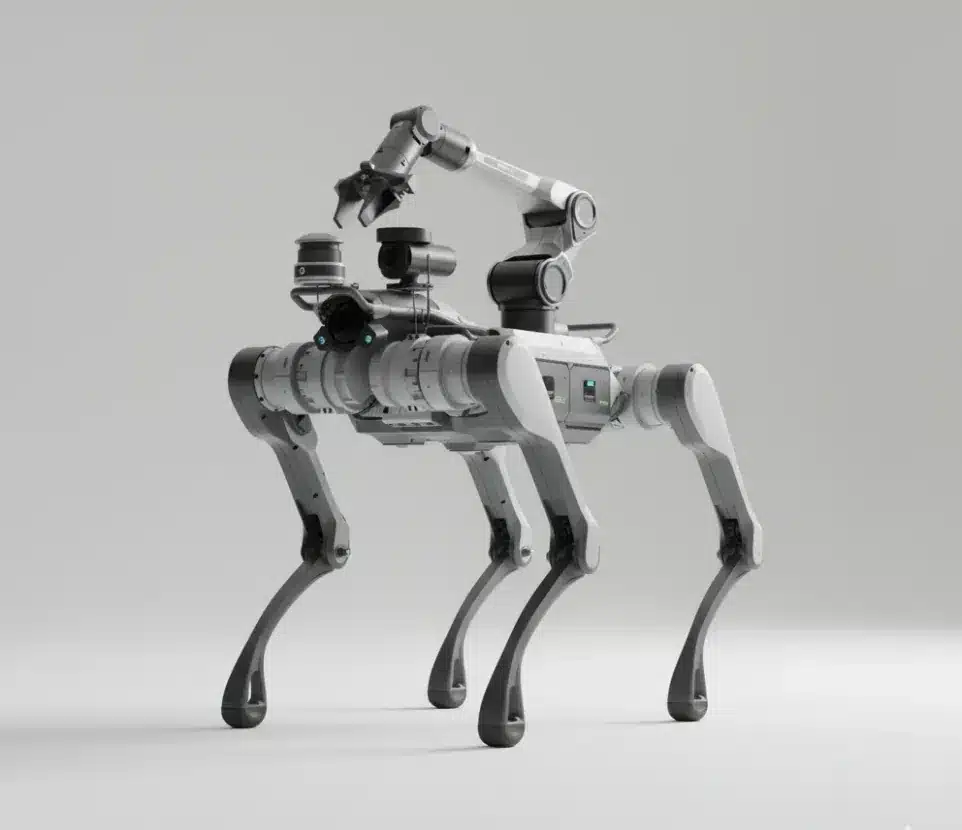
The robot does not just observe: it opens, operates, picks up, moves. The operator drives the arm remotely with a VR headset and depth camera, perceiving the scene in three dimensions and working with real spatial references rather than a flat image.
- Applications: operations in hazardous environments, sample collection, opening of valves and controls
- Control: VR teleoperation with visual depth feedback
- Arm, degrees of freedom and reach: defined by the application
Custom payload to operational specification
When the requirement does not fit a standard configuration, the payload is designed. DroneBase builds dedicated mounts, integrates third-party sensors, develops the data acquisition and transmission chain and the interface with the systems already in use.
- Process: requirement analysis → feasibility study → prototype → field testing
- Fields: environmental, radiometric, acoustic and inspection sensors
- Design constraint: 25 kg while walking, on-board power and buses available
Already have a payload in mind? We will prepare a dedicated configuration.
Mapping a tunnel without sending anyone in
In a tunnel there is no satellite signal, often no lighting and almost never room to manoeuvre a vehicle. It is the environment where the quadruped + SLAM combination delivers the most: the robot goes in, walks the full length and reconstructs the geometry as it goes.
The result is not just a survey video. It is a three-dimensional model that can be compared over time: the same scan, repeated months apart, highlights deformations, detachments, changes in cross-section and build-ups.
- GPS-free survey, with localisation built by the robot along the route
- No operator exposed to the internal atmosphere during acquisition
- Repeatable routes for comparison between successive survey campaigns
- On-board lighting and front and rear LiDAR perception
- Can be combined with gas sensors in the same mission
From inspection to intervention
Seeing a problem from a distance is useful. Being able to act on it is far more so. With a robotic arm on board, the A2 Pro becomes the operator's hand in an environment the operator cannot or must not enter.
Control is via VR headset and depth camera: the scene is reconstructed in three dimensions, so the operator perceives real distances and clearances. It is the difference between driving while watching a screen and driving from inside the environment.
- Operating valves and controls in restricted or hazardous areas
- Collecting samples and carrying them out of the environment
- Removing or placing light objects along the route
- Close-up inspection with the sensor carried by the arm rather than the body
- Operator in a safe position, away from the source of risk
Unitree A2 Pro at a glance
Manufacturer-declared data. The final configuration — payload, batteries, sensors and software — is defined together during the project phase.
Where a quadruped platform is deployed
Each area requires a different configuration of sensors, routes and data management. No two configurations are alike.
Industrial plants
Recurring inspection patrols on lines, switchboards and machinery, with thermal readings and anomaly detection.
Tunnels and galleries
SLAM survey of the full length, lining condition checks, comparison between successive campaigns.
Confined spaces
Preliminary atmosphere testing and visual checks before personnel enter.
Infrastructure
Inspection of underpasses, plant rooms, shafts and structures that are hard to reach with conventional means.
Fire safety
Night-time thermal watch over storage areas and at-risk zones, with early hot-spot detection.
Emergency and rescue
Reconnaissance in unstable or contaminated environments before operational teams go in.
Logistics and warehouses
Recurring inspection routes over large areas, including different floors connected by stairs.
Research and development
Open platform for universities, research centres and industrial projects on perception and autonomy.
The robot is the starting point, not the project
Buying a platform is easy. Making it work inside an operational process — with the right payload, usable data and people able to run it — is the real work.
Application analysis
We start from the operational problem and the real environment, not from the catalogue. Together we define routes, data to collect and site constraints.
Configuration and integration
Payload selection, mounting, power, communication and integration with the systems already in place at your company.
Custom development
When a payload that does not exist is needed, we design it: from prototype to field testing, with in-house R&D capability.
Operator training
Staff training on use, maintenance, mission management and interpretation of the data produced.
Service and spare parts
Ongoing technical support, maintenance and spare-parts management to keep the platform operational over time.
Project documentation
Configuration sheets, operating procedures and technical documentation supplied with the delivered solution.
No aviation authorisation. Site rules still apply.
A ground robot does not fall under drone regulations. The obligations to manage are the workplace safety rules of the environment where it is used.
No aviation constraints
Unlike drones, using the A2 Pro requires no flight authorisations, UAS operator registrations or airspace assessments. Introducing it on a site is a safety and integration project, not an aviation authorisation process.
Workplace safety and confined spaces
The general obligations relating to the working environment and equipment remain. The robot reduces personnel exposure but does not replace site procedures: the specific aspects need to be reviewed together before introduction.
Before we talk
Is specialised staff needed to operate it?
Day-to-day operation is within reach of a trained technician: the robot autonomously manages balance, gait and obstacle negotiation. The level of mission autonomy depends on the chosen configuration. Staff training is part of the delivery process.
Can it carry several payloads at the same time?
Yes, within the 25 kg walking payload limit and subject to power, dimensions and balance. Common combinations are thermal plus gas sensors, or SLAM plus a visible camera. Compatibility is verified during configuration.
Does it work without GPS and without network coverage?
Localisation in enclosed environments relies on on-board perception — LiDAR and cameras — not on satellite signal. Real-time data transmission, however, requires adequate connectivity or a repeater along the route, to be assessed on the specific site.
What is the real runtime in a typical mission?
The manufacturer declares around 3 hours or 12.5 km with a 25 kg load and around 5 hours or 20 km unloaded, under laboratory conditions. The real figure depends on terrain, slopes, temperature and payload. The dual hot-swap battery allows the mission to continue without powering the robot down.
Does it integrate with the systems already in place at our company?
The platform exposes standard interfaces (Ethernet, USB, CAN/RS485, Wi-Fi 6) and supports secondary development in ROS 2. Integration with existing supervision systems, alarm control rooms or management software is assessed case by case.
What authorisations are required?
The aviation regulations that apply to drones do not apply here. The general workplace safety obligations relating to the working environment and equipment remain. The specific aspects of your site need to be reviewed together before the robot is introduced.
Is a trial or demonstration possible?
Yes. The format depends on the application and site conditions: describe your scenario and we will suggest the most useful form of evaluation, from a demo in a controlled environment to a trial on a real route.
How do I request a quote?
Fill in the form at the bottom of the page and describe the environment, objective and payload of interest in the Notes field. We will return a preliminary technical assessment and, if the solution is suitable, a configuration proposal.
Describe your application to us
Tell us about the environment and the operational problem. We will return a preliminary technical assessment: whether a quadruped is the right answer, which payload configuration would make sense and what it takes to bring it to your site.
 Why DroneBase
Since 2012, Europe’s reference point for professional UAV technology
DJI Super Gold Dealer, the only one in Europe. Headquarters, warehouse, service centre and demo area in Rimini, Italy: you see the system working before you buy it, and this is where it comes back for maintenance and updates.
- ISO 9001 certified — certified quality in sales, training and service
- Training with certified instructors — DroneBase Academy, pilot certificates and STS scenarios
- Technical and regulatory consulting on complex scenarios, ENAC and EASA
- R&D for complex projects and tailor-made integrations
- Full support, before and after the sale, with a dedicated technical contact
Let's talk about your inspection environment
In the Notes field, tell us the working environment, the sector and the payload of interest (thermal + visible, gas and dust, fire detection, 3D SLAM, robotic arm, custom configuration): it helps us prepare a technical rather than generic answer. Fill in the form: one of our specialists takes charge of your request and gets back to you with the technical and commercial information and, if needed, to arrange a consultation or a demo. No obligation.