Cargo drones for transport: deliveries where vehicles cannot reach
Up to 85 kg payload, precision winch, redundant multi-sensor safety.
The heavy-lift aerial delivery system for industrial, healthcare and emergency logistics: it carries materials to high altitude, islands, construction sites, pylons and offshore platforms in minutes rather than hours. DJI FlyCart 30 and FlyCart 100 platforms, training, regulatory support and service from a single partner.
FlyCart 100
at full load
altitude
every flight phase
water jets
up to 1.2 m/s
Figures refer to the DJI FlyCart 100 with dual battery, from the DJI datasheet. Distance measured at a take-off weight of 149.9 kg in windless conditions: actual performance depends on payload, weather and firmware.
Traditional delivery stops where the road ends.
Congested traffic, inadequate infrastructure, inaccessible terrain, timelines no longer compatible with market demands. Industrial logistics, healthcare emergencies, mountain and maritime rescue require solutions that go beyond the terrestrial paradigm.
A shelter above the treeline, a pylon on a ridge, a platform offshore, a construction site on an island: today they mean a helicopter, a team on foot or a wait of days. In each of these cases the cost of transport often exceeds the value of what is transported.
The cargo drone changes the terms of the problem: an unmanned aerial platform carries up to 85 kg from point A to point B as the crow flies, with centimetre-level precision and without exposing anyone to risk.
Three structural limits of ground logistics
On an urban delivery they go unnoticed. On a resupply at altitude, in an emergency or at sea they determine the time, cost and safety of the entire operation.
Timelines incompatible with urgency
Hours or days to reach isolated destinations. In healthcare, rescue and critical infrastructure maintenance the wait is not an inconvenience: it is the factor that decides the outcome of the intervention.
Risk to personnel
Porters on exposed trails, technicians climbing pylons and turbines with material on their backs, helicopters in marginal conditions. Every difficult delivery puts people where they should not be.
High cost per mission
Fuel, dedicated vehicles, personnel, intermediate depots. On recurring missions the cost of transport becomes a structural budget line, with emissions that weigh on ESG targets.
What the DroneBase Delivery System is and how it works
Definition
The DroneBase Delivery System is a heavy-lift class unmanned aerial platform, based on the DJI FlyCart 30 and FlyCart 100, engineered to transport payloads up to 85 kg with centimetre-grade precision, redundant safety architecture and extended operational range. It is not simply a drone: it is an integrated ecosystem of hardware, software, sensors, safety systems and certified operational support, delivered turnkey.
Three components, one logistics chain
The system arrives complete: aircraft, payload system and mission-planning software. The operator manages the mission from a single remote controller, with a certified pilot supervising or in autonomous mode along the route.
-
Heavy-lift aircraft Carbon-fibre composite frame, eight pairs of coaxial rotors with 62-inch propellers, dual battery with redundancy and hot-swapping. It folds for transport and is ready for take-off within minutes.
-
Interchangeable payload system Flagship Winch System with electric hook and 30 m cable, or Dual-Battery Lifting System for long-range transport. Real-time payload weighing and automatic residual range calculation.
-
Mission software and O4 transmission Route planning, loading and unloading points, risk analysis and a log of every operation. Video transmission up to 20 km (FCC, 10 km CE), 4G enhanced backup and RC Plus 2 with 7" screen.

Winch or direct release, always configurable
The system supports two interchangeable payload configurations, suited to every operational scenario: from standard cargo transport to precision deliveries on terrain where landing is impossible or unsafe. One platform, two delivery modes.
The Flagship Winch System lowers the cargo from above while the drone hovers, with a triaxial force sensor and algorithms that minimise swing. The Dual-Battery Lifting System maximises range on long-distance missions with standard payloads.
- Flagship Winch System — operating cable 0 to 30 m, retrieval up to 1.2 m/s even with heavy loads, automatic or manual release via app
- Dual-Battery Lifting System — 10 to 15 m cable, emergency cable release, long-range configuration
- Real-time weighing of the payload on every operation, with automatic residual range calculation
- Electric hook opened and closed via app or redundant physical button
- Intelligent deceleration and anti-collision protection during approach phases
- Synchronised A/B points from the RTK-equipped remote controller, with AR projection for rapid positioning
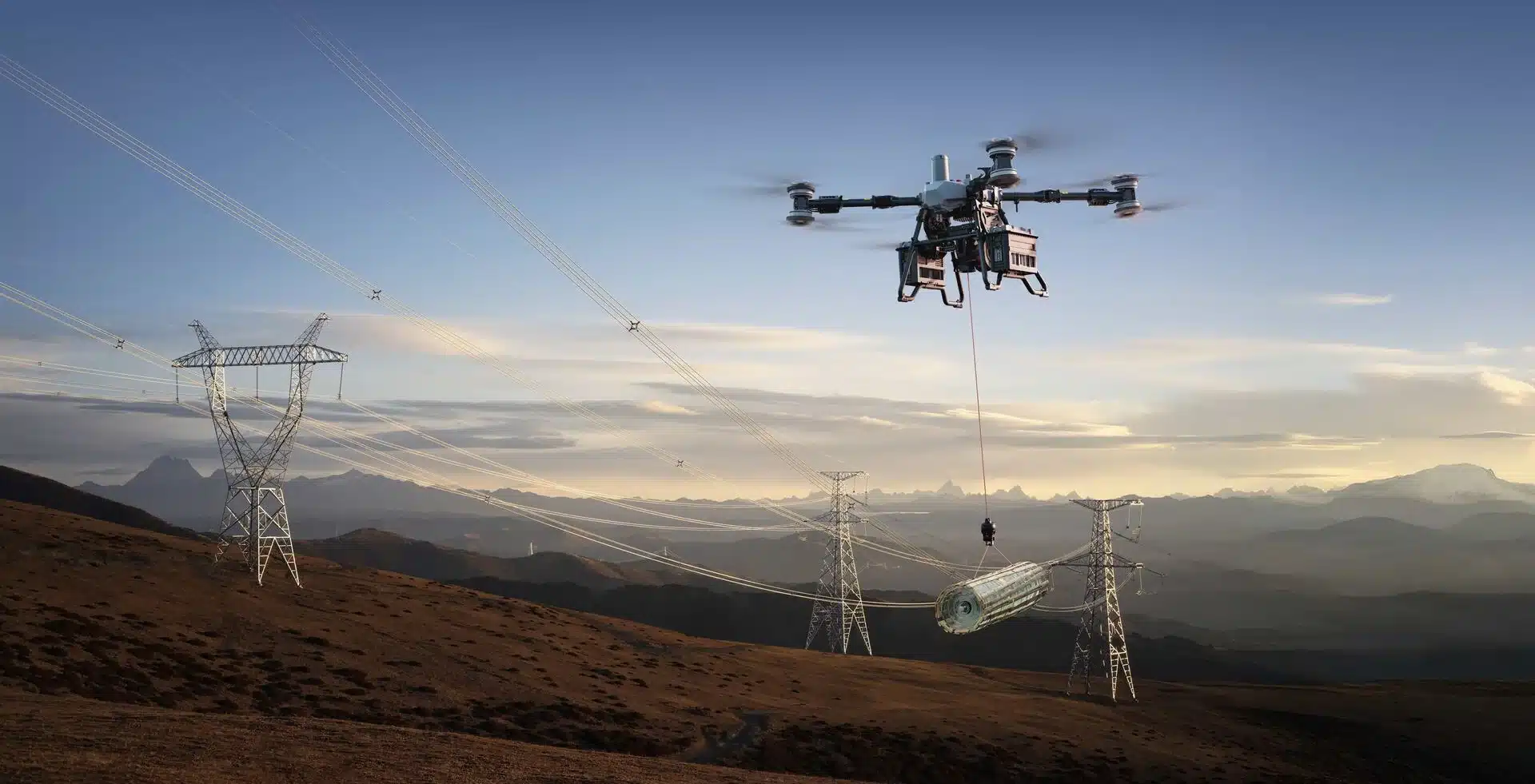
Cargo drone delivery operation: the winch lowers the load while the aircraft hovers in position
Not sure whether your scenario needs the FlyCart 30 or the FlyCart 100? We assess payload, distance and delivery point together in a 20-minute call.
Four layers of protection, zero compromises
The system's safety stems from a redundant multi-sensor architecture in which every component works in synergy to prevent incidents. Obstacle detection occurs on all axes and under any lighting conditions, integrating LiDAR, millimetre-wave radar and stereo vision. The parachute is the last line of defence: always active, independent from the main system.
1 · High-resolution LiDAR
Vertical field of view of 272° and horizontal of 60°. Real-time terrain perception to maintain the preset minimum safety altitude, even over complex relief.
2 · Millimetre-wave radar
Front radar with 360° horizontal and ±45° vertical coverage, plus rear and ventral radar. Obstacle detection up to 60 metres, independent of lighting.
3 · Vision system
Stereo vision with 360° horizontal and 180° vertical coverage. AR detection of pedestrians and vehicles during take-off and landing, landing-point projection on return.
4 · Integrated ballistic parachute
Manual or automatic deployment from a minimum altitude of 100 m, touchdown speed reduced to 7 m/s at full load. Independent power supply and memory, propellers stop before opening.
Redundancy where you cannot see it
In dual-battery mode the two packs back each other up: if one fails in flight, the other keeps the drone airborne. No-roll flight improves crosswind stability and fault tolerance of the propulsion system; the independent flight memory records the last 10 missions in real time.
- Dual battery with redundancy and hot-swapping without interrupting operations
- Propeller stop protection and fault-tolerant propulsion control
- ADS-B receiver for air traffic awareness (with Flagship Winch System)
- DJI reliability tests: high and low temperature, wind tunnel, winch and parachute cycles

One solution, endless operational scenarios
From healthcare emergencies to industrial logistics, from civil protection support to offshore missions: the cargo drone responds to diverse needs with the same efficiency, safety and reliability.
Healthcare emergency
Rapid transport of blood, organs, life-saving drugs, defibrillators and critical medical devices between healthcare facilities and emergency scenarios.
Mountain rescue
Delivery of equipment, supplies, rescue gear and medical devices in mountain areas inaccessible to ground vehicles or helicopters.
Construction sites
Transport of materials, tools and spare parts to sites at high altitude, on islands or in remote areas. Drastic reduction in supply times.
Energy infrastructure
Delivery of components, spare parts and tools to transmission towers, wind turbines, offshore platforms, dams and remote facilities. Reduced intervention times, no risk to operators.
Maritime operations
Cargo transfer between ships, support to offshore platforms, search and rescue missions on the open sea and port logistics.
Civil protection
Logistical support in emergency scenarios, natural disasters, flooded areas, zones hit by fires or earthquakes. Timely rescue intervention.
Last-mile logistics
Fast deliveries between logistics hubs and peripheral destinations, cutting operational time and costs. Ideal for urgent shipments and critical spare parts.
Isolated areas
Supply of minor islands, mountain shelters, weather stations, lighthouses, scientific bases and rural locations without road connections.
Environmental monitoring
Transport of samples, monitoring instruments, sensors and equipment for scientific research in protected natural areas or hard-to-reach locations.
Security and defence
Support to law enforcement, fire brigades and security operators for the transport of tactical equipment, technical materials and operational tools.
Industrial sector
Movement of materials between production plants, warehouses and distribution centres. Optimisation of large-scale intralogistics flows.
Precision agriculture
Targeted distribution of agronomic products, seeds and materials on large estates, vineyards and speciality crops. Premium harvest transport.
Drone delivery vs traditional delivery
A measurable paradigm shift: speed, costs, environmental impact, territorial accessibility, risk to personnel. Not an alternative, but a structural evolution of the logistics sector.
| Operational parameter | Traditional methods | DroneBase Delivery |
|---|---|---|
| Delivery times | Hours or days | Minutes |
| Territorial accessibility | Limited by road network | Virtually unlimited as the crow flies |
| Operational cost per mission | High (fuel + personnel) | Up to 70% reduction |
| CO₂ emissions | High | Zero direct emissions |
| Emergency operability | Infrastructure-dependent | Immediate and autonomous |
| Point-to-point precision | Approximate | RTK ±10 cm |
| Real-time traceability | Limited or absent | Continuous telemetry |
| Risk to personnel | Significant in hostile zones | Eliminated |
| Logistics footprint | Vehicles, depots, drivers | Minimal operational base |
| Fleet scalability | Slow and costly | Fast and modular |
The cost reduction is an estimate for recurring missions compared with helicopters, road vehicles and dedicated personnel: the actual figure depends on the scenario and is calculated in the preliminary business case.
Two DJI FlyCart platforms, one partner
FlyCart 30 for payloads up to 30 kg over long distances, FlyCart 100 for payloads up to 85 kg on the most demanding missions. The choice depends on typical payload weight, distance to cover and type of delivery point.
DJI FlyCart 30 — Delivery Combo
The compact cargo drone of the range: transport up to 30 kg with dual battery (40 kg with single battery) over distances up to 16 km, with cargo case or 20 m winch.
- Payload 30 kg (dual battery) · 40 kg (single)
- Flight distance up to 16 km at full load
- 20 m winch · IP55 · integrated parachute
DJI FlyCart 100
The heavy-lift flagship: 85 kg payload with dual battery (100 kg with single battery), 170 kg maximum take-off weight, 12 km flight distance at full load and ultra-fast charging.
- Payload 85 kg (dual battery) · 100 kg (single)
- Flight distance up to 12 km at 149.9 kg take-off weight
- Charging 30→95% in 9 minutes · IP55 · -20/+40 °C
FlyCart 100 Flagship Winch System
The flagship winch for the FlyCart 100: electric hook, 30 m cable with retrieval up to 1.2 m/s, triaxial anti-swing force sensor and integrated ADS-B receiver.
- Operating cable 0–30 m
- Retrieval up to 1.2 m/s with heavy loads
- Automatic or manual release · electric hook
FlyCart 100 data from the DJI datasheet; FlyCart 30 data from the DJI datasheet, to be confirmed at quotation stage. Configurations (batteries, power supplies, payload system) are defined during sizing.
Numbers that make the difference
Carbon-fibre composite frame, eight pairs of coaxial rotors with 62-inch propellers, 155 mm stator, 420 A ESC. Every structural and propulsion element is designed for stability, efficiency and durability over thousands of operational cycles. The aircraft folds towards the body for compact transport and redeploys within minutes.
Power and charging DB2160/DB2212 intelligent batteries with triple air-channel cooling. C12000 three-phase 12 kW power supply, C10000 single-phase 9 kW or D14000iE 11.5 kW inverter generator for operations without grid access. Battery heating with the Battery Incubator for cold climates.
Open PSDK ecosystem E-Port Lite interface and PSDK power supply up to 3,000 W for third-party payloads: thermal cameras, sensors, custom release systems. 2,330 mm wheelbase, 55.2 kg dry weight, 8×2 rotors with 62" carbon propellers.
Data refer to the DJI FlyCart 100 datasheet. The 170 kg maximum take-off weight is a performance specification: in operation the limits of the applicable regulation apply.
Want to see the FlyCart in flight with a real load? We organise a demo at our Rimini headquarters or at your operational site.
From planning to delivery in 4 steps
A structured, repeatable operational process, supported by dedicated software and certified safety protocols. Every mission is designed, monitored and tracked end-to-end.
-
Mission planning Route definition, operational risk analysis, verification of flight authorisations and range calculation based on payload. All centralised in the mission software.
-
Automated take-off Pre-flight check of critical systems, payload anchoring, activation of safety sensors. Vertical take-off supervised by a certified pilot or in autonomous mode.
-
Flight and monitoring Flight along the planned route with real-time telemetry, active obstacle avoidance and stable video transmission. Manual intervention possible at any moment.
-
Delivery and return Precision cargo release via winch or controlled landing. Delivery confirmation, operation log and automatic return to base for the next mission.
Advantages that transform your operations
Not just technology: a complete partnership including specialist consulting, certified training, scheduled maintenance and continuous operational support. All from a single point of contact.
Reduced operational times
Deliveries that take hours with traditional means are completed in minutes, even on complex terrain. A concrete advantage in sectors where every minute counts.
Cost reduction
Up to 70% lower operational costs compared with helicopters, road vehicles and dedicated personnel on recurring missions. Measurable return from the first months of operation.
Environmental sustainability
100% electric propulsion with zero direct emissions. A concrete contribution to ESG targets and the decarbonisation policies required by European regulation and major institutional clients.
Certified training
DroneBase Academy trains specialised pilots with courses compliant with EU Regulation 2019/947 and ENAC-recognised certificates (Italy). Qualified, always up-to-date operational personnel.
Premium technical support
Authorised service centre certified ISO 9001:2015. Scheduled maintenance, original spare parts, rapid repairs and dedicated technical support with contractual SLAs.
Regulatory compliance
Full support for EASA authorisations, STS standard scenarios, SORA analysis, operational declarations and all required regulatory documentation. Operations in full compliance.
24/7 operability
Day and night operational capability, with integrated lighting up to 46 W and sensors that work even in low-visibility conditions. Authorised night missions.
Measurable ROI
Personalised return-on-investment analysis for each sector. Feasibility studies, business cases and concrete economic projections before adopting the system.
Modular solution
A system scalable to real operational needs: purchase, operational leasing, turnkey DaaS formula, purchase via MEPA (Italy) for public bodies. Maximum contractual and operational flexibility.
The questions we hear before purchase
How much can a cargo drone really carry?
The DJI FlyCart 100 carries up to 85 kg with dual battery and up to 100 kg with single battery; the FlyCart 30 up to 30 kg with dual battery and 40 kg with single. The actual payload depends on distance, altitude, temperature and configuration: we verify it together during sizing.
What distance does it cover with the load on board?
The FlyCart 100 reaches 12 km of flight distance at 149.9 kg take-off weight, in standard conditions. The FlyCart 30 reaches around 16 km at full load. In practice the useful mission distance is calculated considering the outbound leg, the return and a safety margin, and is confirmed by the planning software based on the actual payload.
FlyCart 30 or FlyCart 100: which one to choose?
The FlyCart 30 suits payloads up to 30 kg over long distances and frequent operations with lighter logistics. The FlyCart 100 is needed when the weight of a single load exceeds 30 kg: industrial components, construction materials, heavy rescue equipment. The choice is often made on the maximum recurring load, not the average one.
How does delivery work if landing is not possible?
With the winch: the drone hovers and lowers the load on a cable up to 30 m (FlyCart 100) or 20 m (FlyCart 30), with an electric hook that opens automatically or manually. Real-time weighing and the force sensor reduce swing and confirm release. Alternatively the load travels in the cargo case with a controlled landing.
Which authorisations are required to operate?
Transport with drones of this class falls within the specific category of EU Regulation 2019/947: a certified pilot, risk analysis (SORA or applicable standard scenario) and authorisation from the national aviation authority (ENAC in Italy) for the operational scenario are required. DroneBase supports the whole process, from documentation to staff training with DroneBase Academy.
Does it work in the mountains, in wind and extreme temperatures?
Yes, within datasheet limits: wind resistance up to 12 m/s in all flight phases, operating temperature from -20 to +40 °C, IP55 protection against dust and water jets, maximum flight altitude of 6,000 m. For cold climates the Battery Incubator keeps the batteries at their optimal temperature.
What happens in the event of a failure in flight?
The system is redundant on several levels: in dual-battery mode the two packs back each other up, the propulsion system tolerates power loss with No-roll flight, and the integrated ballistic parachute opens manually or automatically from 100 m altitude, reducing touchdown speed to 7 m/s at full load. The independent memory records the last 10 missions.
How can I purchase or lease the system?
Direct purchase, operational leasing with a monthly fee, DaaS (Drone as a Service) formula with pilot and operational management, purchase via MEPA (Italy) for public bodies, law enforcement, fire brigades and civil protection. Request a Quote stating typical payload, distance and delivery point in the notes: we prepare the configuration and business case.
 Why DroneBase
Since 2012, Europe’s reference point for professional UAV technology
DJI Super Gold Dealer, the only one in Europe. Headquarters, warehouse, service centre and demo area in Rimini, Italy: you see the system working before you buy it, and this is where it comes back for maintenance and updates.
- ISO 9001 certified — certified quality in sales, training and service
- Training with certified instructors — DroneBase Academy, pilot certificates and STS scenarios
- Technical and regulatory consulting on complex scenarios, ENAC and EASA
- R&D for complex projects and tailor-made integrations
- Full support, before and after the sale, with a dedicated technical contact
Let's design your aerial logistics
Our specialists assess your operational needs, demonstrate the system's capabilities in the field and design the delivery solution best suited to your sector. Fill in the form: one of our specialists takes charge of your request and gets back to you with technical and commercial information and, if needed, to arrange a consultation or a demo. No obligation.