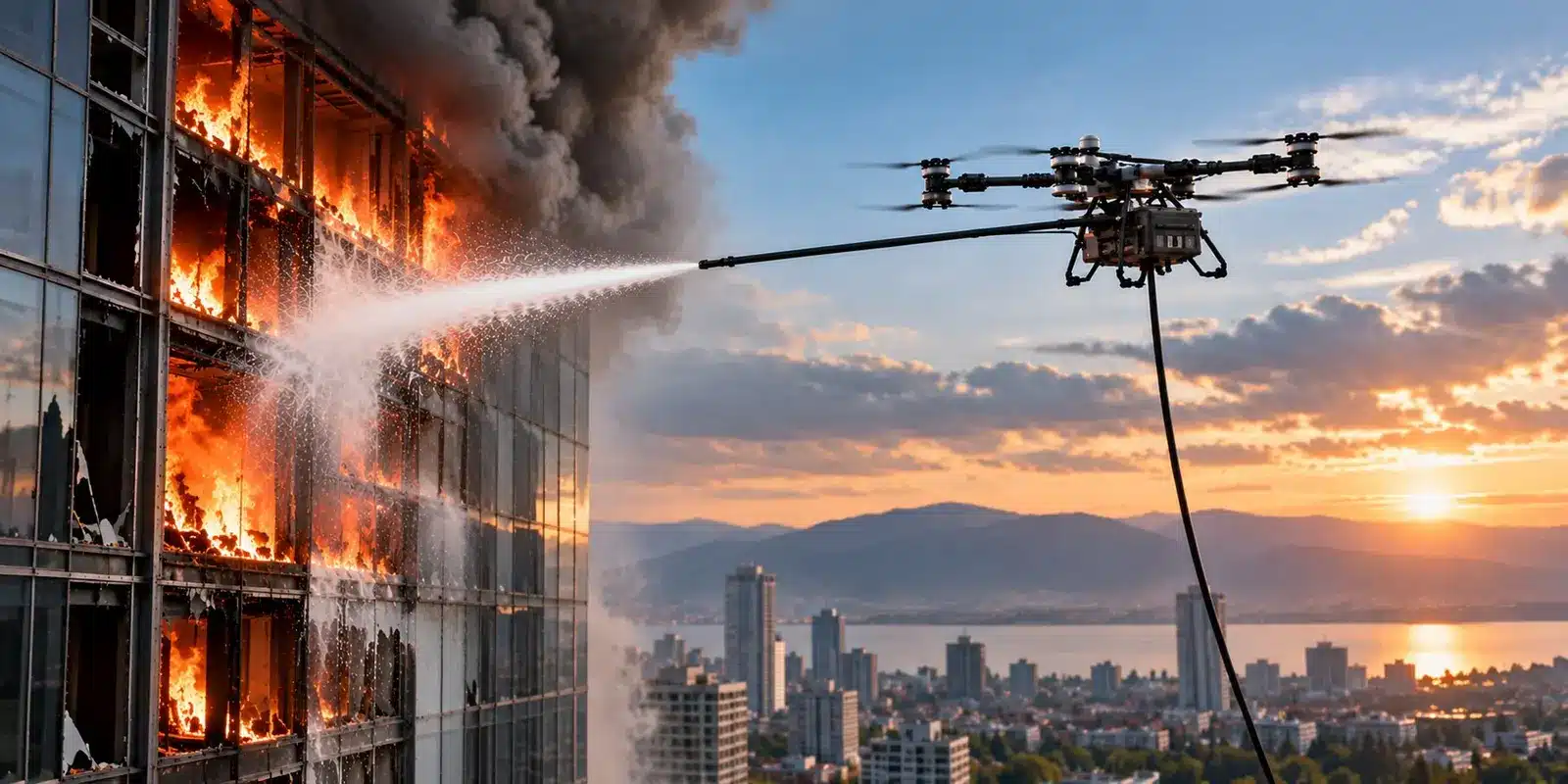
Firefighting drone with lance and tethered power
A water jet at height where aerial ladders and cranes cannot reach.
The drone is linked to the ground by a cable that powers it continuously and by a hose that carries water from the pump or fire tender. No battery swaps, no interruptions: the jet stays on the fire for as long as needed. A system integrated by DroneBase on DJI FlyCart 100 for fire brigades, industrial fire services and public bodies.
- Continuous ground power, over 6 hours of hovering flight
- Lance with adjustable jet and 10–15 m effective reach
- Operators on the ground, nobody on the facade
of the tether cable
hovering flight
from the lance
set-up time
Manufacturer data. Discharge height and actual flow rate depend on hose length and on the pressure available at ground level.
When the appliance cannot reach the burning floor
A firefighting drone with lance operates where aerial ladders and cranes cannot: those appliances have a limited working height and need space, load-bearing ground and a clear access route. In historic centres, inner courtyards and in front of buildings with continuous facades, those conditions are often missing.
Heights out of reach
Upper floors, roofs and facades stay beyond the reach of the appliance, or can be reached only with lengthy manoeuvres.
No room to manoeuvre
Alleys, courtyards, cluttered yards or weak floors prevent the aerial ladder from being positioned.
Operator exposure
Working from the cage in front of a flame front means heat, smoke and collapse risk.
Battery endurance
A battery-powered drone cannot sustain a continuous jet: after a few minutes it has to land and swap packs.
With ground power the aircraft stays at height for hours; with the lance it puts water exactly on the point the operator is aiming at.
What a firefighting drone with lance is and how it works
The drone carries neither water nor batteries: it receives both from the ground, where appliances and operators remain.
Definition
A firefighting drone with lance is an extinguishing system in which a cargo drone lifts a lance connected, via hose, to a pump or fire tender on the ground. In the tethered configuration the drone is powered by a ground station through a cable, so it can hover for hours without battery changes. It is designed for fire brigades, industrial fire services, public bodies and industrial site operators who need to deliver a continuous jet onto upper floors, facades and roofs that conventional appliances cannot reach.
- Water sourceFire tender, hydrant or tank: the supply remains the one the crew already uses.
- PumpPressurises the line upwards: ground pressure is what determines the jet at height.
- Dedicated hose25 mm line, 90 or 150 m long, with a single-piece forged coupling on the lance.
- Lance on the droneQuick-release mount on the aircraft, adjustable jet angle, water or foam.
- Tethered stationPowers the drone via cable from mains or generator and manages automatic cable winding.
Water supply provided by the operator. The system plugs into the chain already in use — fire tender, hydrant or pump — and does not replace existing appliances: it takes them where they cannot reach.
Not sure whether the configuration covers the heights in your scenarios? We check it together in a 20-minute call.
Drone fire lance: a targeted jet from above, at a safe distance
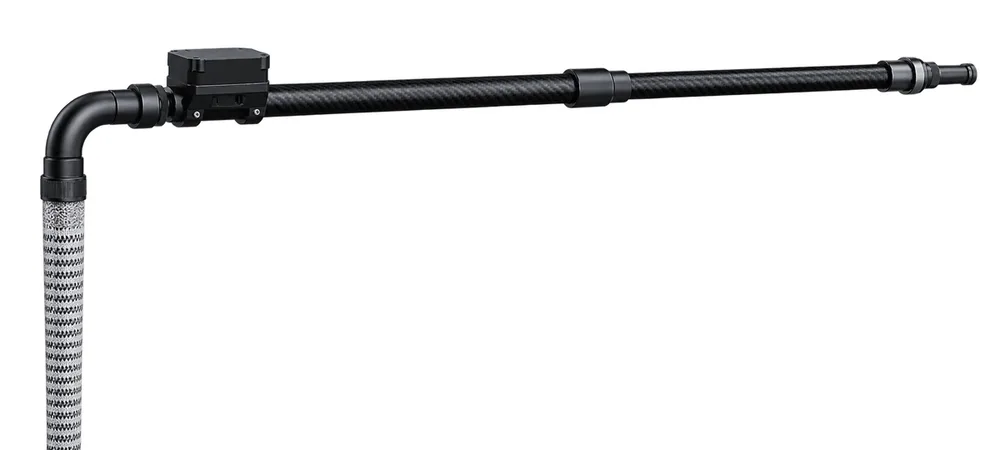
Modular quick-release kit with 16 mm nozzle, adjustable discharge angle and single-piece forged coupling on the hose: no risk of the hose slipping off or leaking under pressure during prolonged operations.
Quick release
Modular interface: fitted to and removed from the aircraft in about 30 seconds.
Adjustable jet
Variable discharge angle, indicative working area of 6 × 6 m.
Water or foam
Compatible with water and foam concentrate, depending on the type of fire.
Low weight
0.93 kg nozzle; complete kit with 90 m hose around 9.65 kg.
Product sheet: fire lance for DJI FlyCart 100 / Agras T100 (25 mm).

Drone fire lance with forged hose coupling
Tethered drone: power from the ground, no battery swaps
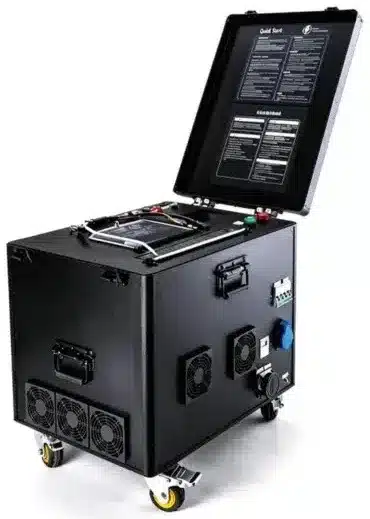
A 30 kW mobile station draws power from the mains or a generator and transmits it to the drone as high-voltage DC. The 20 kW airborne module has the shape of the original battery and slots into the same bay, with no modification to the aircraft.
Over 6 hours in flight
Continuous hovering with no landings: the limit becomes the ground power supply.
Cable up to 220 m
Automatic winding adjustable up to 2 m/s, over 1,000 cycles, breaking load ≥ 300 kg.
Rapid deployment
Station operational in under 10 minutes, with 380 V three-phase supply from mains or generator.
Electrical protections
IP54 airborne module with voltage, current, short-circuit and temperature protection.
Operating height depends on cable configuration, hose length and the pressure available on the ground: it is defined during the scenario study. Product sheet: FlyCart 100 tethered system, 220 m.

Drone powered via cable from the ground tethered station
What you can do with the firefighting drone with lance
Attack at height
Take the jet to upper floors, walkways and roofs without waiting for the aerial ladder to be positioned.
Cool surfaces
Wet facades, window frames and exposed roofs to slow the spread to neighbouring buildings.
Work in tight spaces
Courtyards, alleys and cluttered areas: the drone only needs the take-off spot next to the station.
Stay on the fire
Cable power removes the pauses for battery changes during discharge.
Work in the dark
On-board lighting and an optional searchlight make the system usable at night too.
See before entering
Reconnaissance from above reaches the command post and guides the attack decision.
How the building intervention changes
The system does not replace conventional appliances: it complements them where they cannot reach.
Conventional appliances only
- Working height tied to the available appliance
- Needs space, access and load-bearing ground
- Operator in the cage facing the flame front
- Positioning and stabilisation times
- Inner facades and courtyards often unreachable
- No reconnaissance from above
With the DroneBase system
- Height reached by the aircraft, not the appliance
- Only the take-off area next to the station is needed
- No operator exposed on the facade
- Station operational in under 10 minutes
- Access to courtyards, light wells and roofs
- Real-time aerial view at the command post
From configuration to mission in three steps
We study the scenario
Building heights, take-off spaces, available water resources and line pressure.
We configure the system
Integration of aircraft, lance and tether; testing of the jet and of emergency procedures.
You are operational
Delivery, support with the authorisation process, operator training and dedicated assistance.
Scope of supply — airborne segment
Aircraft, lance, cable power, safety and commissioning. The water supply remains the operator's own: fire tender, hydrant or pump.
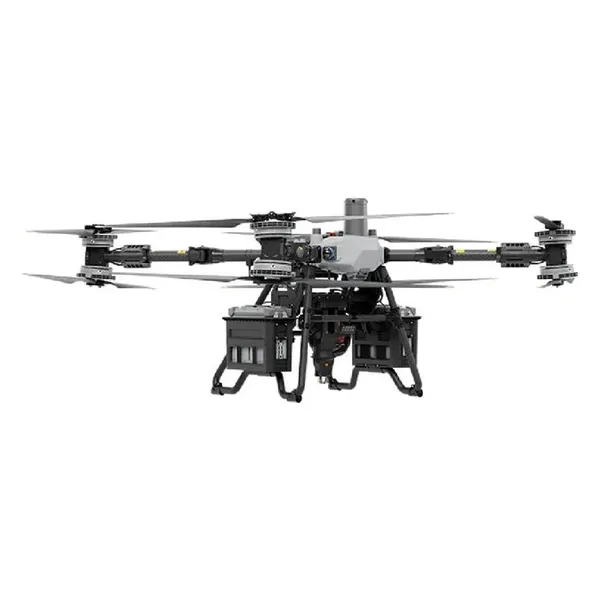
DJI FlyCart 100 cargo drone
Heavy-lift aircraft with radar, LiDAR and IP55 protection. FlyCart 100 data sheet.
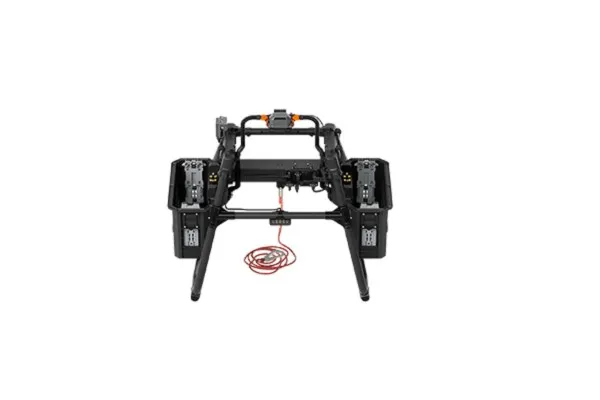
Dual lift system
Payload attachment interface for the aircraft.
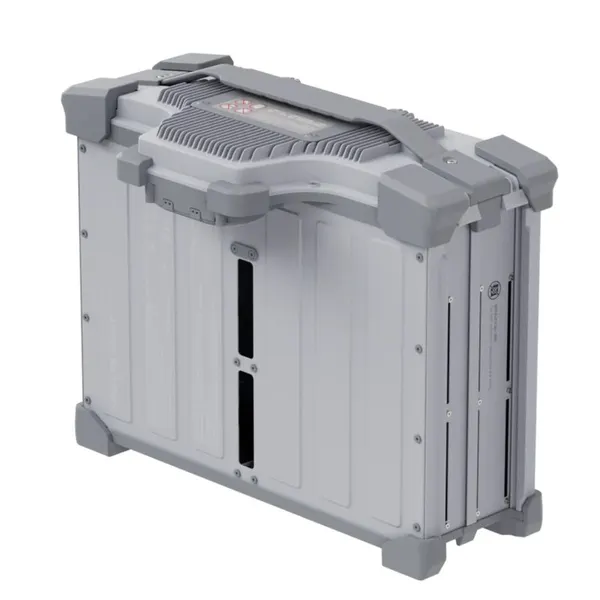
Flight batteries
For transfers and untethered missions.
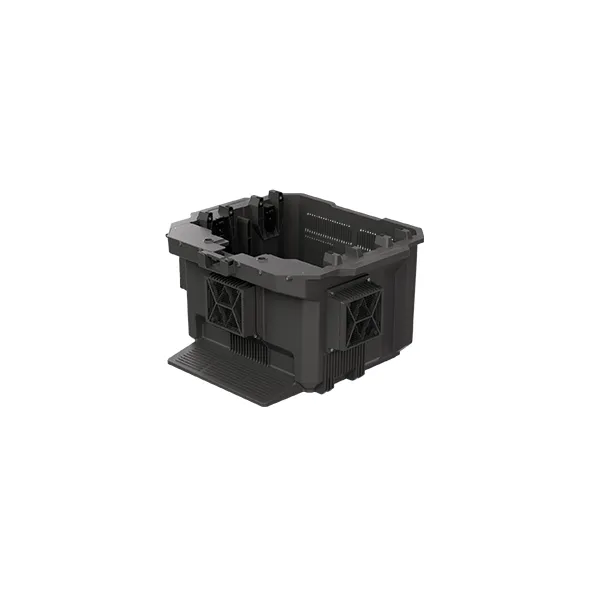
DB2160 air cooler
Cools the batteries between uses.
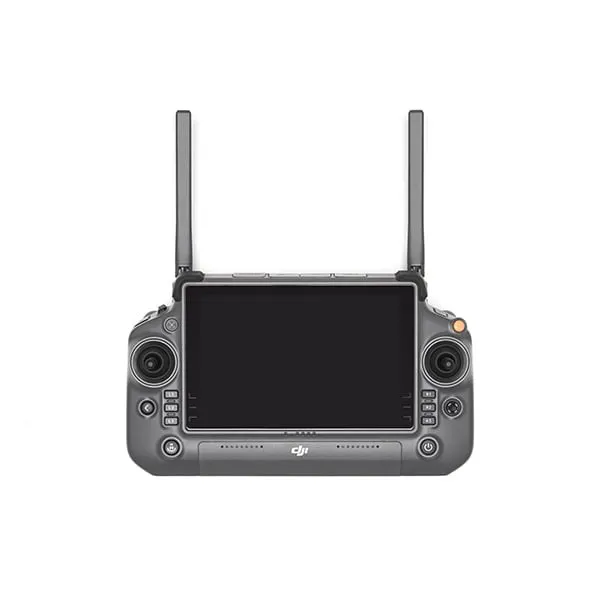
RC Plus 2 remote controller
7″ high-brightness screen, O4 transmission.
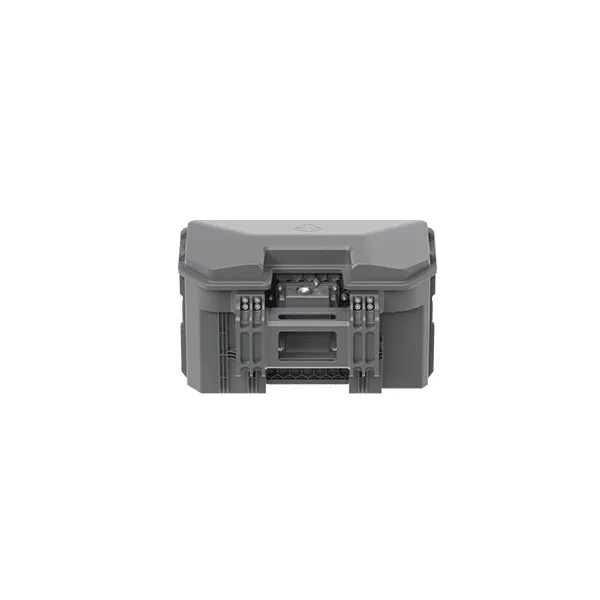
FC100 parachute kit
Ballistic protection, a requirement for flight above 25 kg.
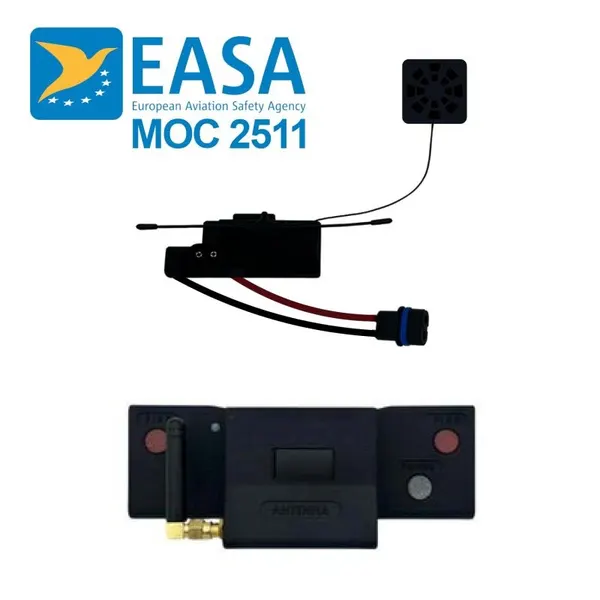
Flight termination system (FTS)
MOC-2511 certified, independent radio channel.
Integration and commissioning
Testing, authorisation support, training and assistance.
Recommended accessories (optional)
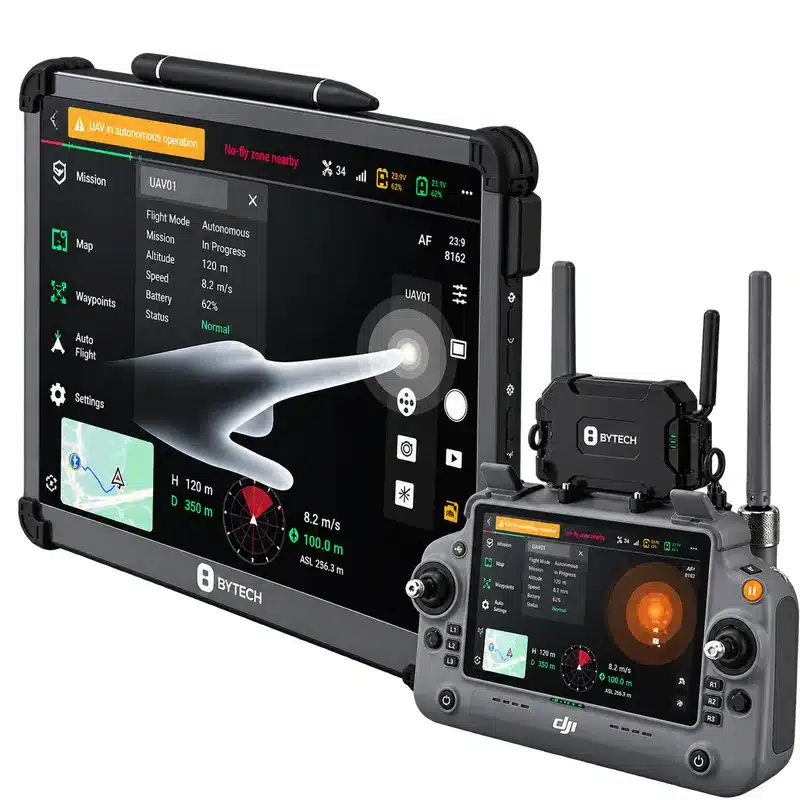
14″ field display, 1,500 nits
Brings the drone feed to the command post on a screen readable in full sunlight, with no cables. With reverse control, the operations manager can act on the flight interface directly from the display.
- 14″ screen, 2560 × 1600 px, 1,500 nits
- Transmission from the remote controller up to 200 m
- One-to-one and one-to-many modes for multiple displays
- 6,000 mAh battery, about 4 h runtime
- Aluminium body, IP43, about 1.3 kg
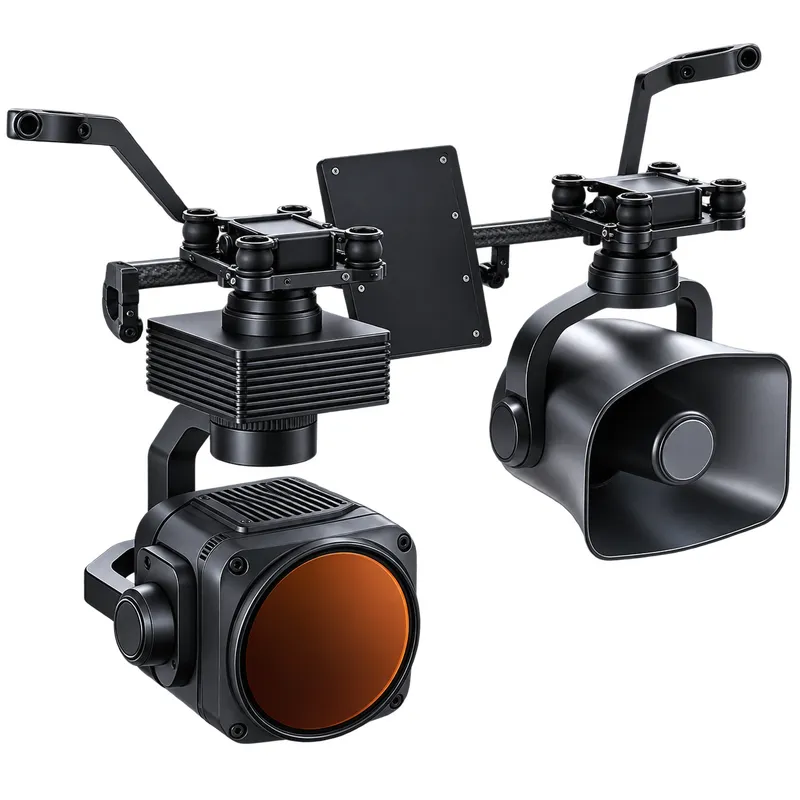
2-in-1 loudspeaker and searchlight kit
A single quick-release payload: lights up the facade during night operations and broadcasts messages and alarms to occupants or crews, controlled from the drone's remote controller.
- Searchlight: 30,000 lm, 300 W peak, 16.7° beam, 0–90° tilt
- 15 m spot at 50 m altitude, 30 m at 100 m
- Loudspeaker: 130 dBA, 500 m effective range
- Live voice, recordings, audio files, text-to-speech
- Searchlight 1.28 kg · loudspeaker 449 g · −20 to +45 °C
The lance is also available in a version for DJI FlyCart 30, for crews already operating that aircraft.
Discover all DroneBase tethered systemsThe final scope of supply is confirmed during the scenario study. Accessory data from manufacturer data sheets.
Fire lance and tethered system specifications
Manufacturer data. Performance at height depends on the pressure available on the ground and on the line configuration.
| Lance length | 1,950 mm |
|---|---|
| Lance weight | approx. 0.93 kg |
| Nozzle diameter | 16 mm |
| Hose diameter | 25 mm |
| Total weight with coupling | approx. 9.65 kg (with 90 m hose) |
| Hose length | 90 m or 150 m |
| Effective reach | 10–15 m |
| Working pressure | 2.5 MPa |
| Burst pressure | 3.2 MPa |
| Extinguishing agent | water or foam concentrate |
| Installation | quick-release mount |
| Operating height | up to 220 m (cable length); discharge depends on hose and ground pressure |
| Continuous endurance | over 6 hours of powered flight |
|---|---|
| Cable length | up to 220 m |
| Station power | 30 kW |
| Airborne module power | 20 kW, efficiency ≥ 96% |
| Power supply | 380 V AC three-phase (mains or generator ≥ 25 kW) |
| Cable winding | automatic, 0–2 m/s |
| Deployment | within 10 minutes |
| Cable | breaking load ≥ 300 kg, ≥ 1,000 cycles, insulation ≥ 3,000 VDC |
| Airborne module | IP54, native battery form factor |
| Protections | over/under-voltage, over-current, short circuit, temperature |
Applications of the firefighting drone with lance
Fire brigades, industrial fire services, Civil Protection, operators of industrial, port and logistics sites.
Multi-storey buildings
Fires on upper floors in areas where the aerial ladder cannot be positioned or cannot reach the height.
Historic centres
Narrow alleys, inner courtyards and timber roofs, where heavy appliances cannot enter.
Warehouses and depots
Large roofs and stacked goods, with cooling of exposed structures from above.
Industrial plants
Tanks, silos and process lines that require a continuous jet from a safe distance.
Sensitive sites
Port, logistics and energy areas with a dedicated fire service.
Extended watch
Continuous monitoring and cooling in the hours after extinguishment.
Don't buy components. Rely on those who integrate them.
Since 2012 we have designed, integrated and supported professional and custom UAS systems for public bodies and businesses.
In the UAS sector since 2012
UAS system integrator and manufacturer of professional drones, based in Rimini, Italy.
DJI Super Gold Dealer · ISO 9001:2015
Specialised in the DJI enterprise range, with a certified quality management system.
In-house R&D and production
Mechanical and electronic integration of aircraft, lance and tethered power carried out in-house.
Technical lab and service
Specialised service centre: testing, maintenance and spare parts with support based in Italy.
Training with DroneBase Academy
Operator training on the system and procedures, with support for operational documentation.
Public-sector supply and MEPA
We handle supplies to public bodies, including through MEPA (Italy), with the required technical documentation. How to buy.
Before you buy, we check together that this is the right solution.
Describe your typical scenarios: building heights, take-off spaces, water resources and available pressures. Our engineers indicate the right configuration — or tell you if it is not the right fit.
Answers to the most common questions
At what height can the firefighting drone with lance operate?
The tether cable reaches 220 m; the discharge height depends on hose length (90 or 150 m) and on the pressure available on the ground. The value for your scenario is defined during the study phase.
Is a power outlet needed on site?
The station requires 380 V three-phase power from the mains or from a generator of at least 25 kW: the same supply used for rescue equipment.
Who provides water and pressure?
They remain the operator's responsibility: fire tender, hydrant or pump already in service. The system connects to the line with the lance's dedicated hose.
Can foam be used as well?
Yes, the lance is compatible with water and foam concentrate; mixing takes place on the ground, on the delivery line.
Can the drone also fly without the cable?
Yes. The tethered module is installed in place of the battery: refit the battery packs and the aircraft flies free again for reconnaissance and transport.
How long does it take to become operational?
The tethered station is designed for deployment in under 10 minutes; the lance attaches to the aircraft in about 30 seconds.
Are authorisations required?
Operations fall under the Specific category. DroneBase provides consultancy for SORA and PDRA and for integrating the system into the operator's operating procedures.
Can a public authority purchase it?
Yes. We handle supplies to public bodies, including through MEPA (Italy), with the technical documentation required for the procedure.
How do I get a quote or a demonstration?
Three pieces of information are enough: typical building heights, available take-off spaces and water resources in service. With these we prepare the configuration and a dedicated quote, or arrange an operational demonstration. Request a Quote or Request a Demo using the form at the bottom of the page.
 Why DroneBase
Since 2012, Europe’s reference point for professional UAV technology
DJI Super Gold Dealer, the only one in Europe. Headquarters, warehouse, service centre and demo area in Rimini, Italy: you see the system working before you buy it, and this is where it comes back for maintenance and updates.
- ISO 9001 certified — certified quality in sales, training and service
- Training with certified instructors — DroneBase Academy, pilot certificates and STS scenarios
- Technical and regulatory consulting on complex scenarios, ENAC and EASA
- R&D for complex projects and tailor-made integrations
- Full support, before and after the sale, with a dedicated technical contact
Tell us about your intervention scenario
A DroneBase engineer analyses heights, access routes and available water resources and proposes the right configuration, with the related quote. Fill in the form: one of our specialists takes charge of your request and gets back to you with the technical and commercial information and, if needed, to arrange a consultation or a demo. No obligation.